The Simple Math of Roulette: A Full Study
Main Chances in Roulette
Roulette chance follows clear math rules with each spin. In European roulette, each pocket has a 1/37 chance, while American roulette has 1/38 chances due to an extra double-zero pocket. Each result stands alone, so past spins don’t change what might happen next.
How Betting Works
Bets on Single Numbers
Bets on one number have the best possible wins at 35:1. But, they only have a 2.6% chance to win. Bets on two numbers and bets on four numbers bring lower wins but slightly better odds.
Bets Covering More Numbers
Bets on colors, odd/even numbers, and high/low numbers have the best odds at 48.6%. These choices all pay 1:1, making them a good tactic for careful players.
The Math Behind the House Edge
The casino’s edge comes from a set mismatch between real odds and payout rates:
- European roulette has a 2.7% house edge
- Ultimate Betting Guide
- American roulette has a 5.26% house edge
This gap in chances ensures the casino makes money while still keeping the game fair through clear math rules.
The Wheel’s Math Design
Clean Engineering and Balance
Great engineering is at the base of the roulette wheel’s math shape.
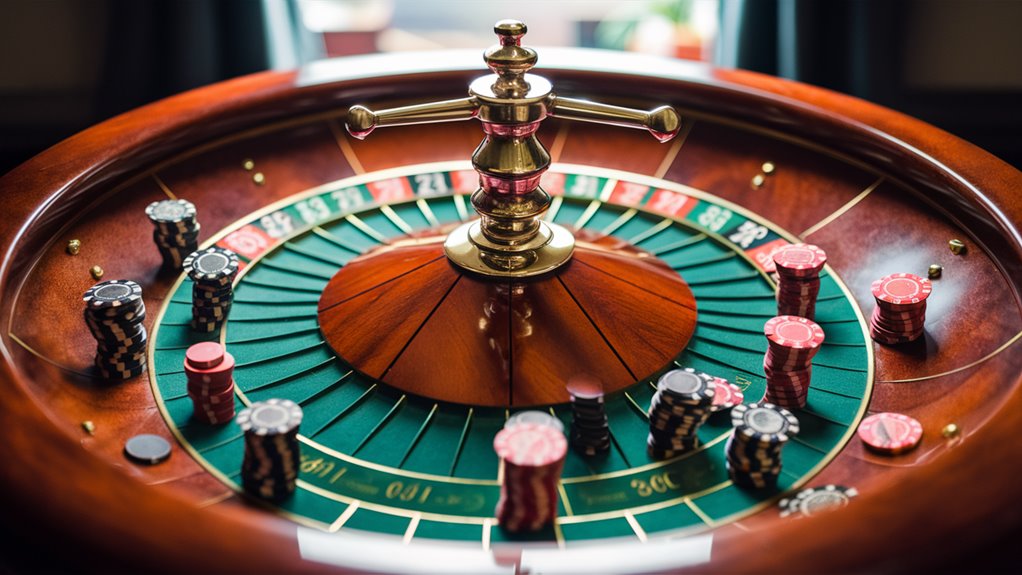
The wheel’s 38 pockets (in American roulette) follow a well-planned order, balancing it all across.
The red and black numbers, marked by green zero and double-zero spots, set the known 5.26% house edge.
Smart Placement of Numbers
The wheel uses a mixed order of numbers that sorts high and low values with top care.
This smart layout sets opposite areas where numbers 1-18 sit across from numbers 19-36 along the wheel.
The smart number setup ensures numbers right next to each other don’t touch, keeping any one area from being more likely.
Exact Measures and True Stats
The wheel’s even weight means each pocket keeps an even 1/38 chance.
Precise checks show just-right 9.73-degree gaps between pockets, and the separators keep even 1/8-inch measures in all ways.
These high standards prevent any one spot from being more likely, so the game stays pure and trustworthy in its math.
Basic Chances in Roulette
Main Chances Basics
The American roulette wheel has a key chance rate of 1/38 for any one number coming up.
This basic chance is key to working out odds for all kinds of bets.
Chances for One Number and Two Numbers
Single number bets hold onto the main chance of 1/38 (2.63%), the most direct kind of roulette chance.
Two-number bets, which cover two close numbers, naturally double this chance to 2/38 (5.26%), giving better odds but smaller wins.
Outside Bet Calculation
Outside bet chances use a simple times rule based on how many spots they cover.
Red/black and odd/even bets cover 18 numbers, giving an 18/38 (47.37%) chance.
Column and dozen bets cover 12 numbers each, making a 12/38 (31.58%) chance of winning.
Separate Events Understanding
The idea of separate events runs roulette chances. Each spin is its own thing, no matter what came before.
This fact goes against the gambler’s mistake – the wrong idea that past results change future odds in things that don’t connect.
Odds Inside Vs Outside
Main Bet Kinds in Roulette
Roulette bets split into two clear kinds: inside bets and outside bets, each with its own chance-to-pay rates.
Knowing these differences is key for making good bet plans.
Inside Bet Odds and Chances
Inside bets focus on certain numbers or small groups of numbers, bringing high payouts but less chance of winning:
- Single number bet: 35:1 payoff with a 2.7% chance to win (European) or 2.6% (American)
- Two-number bet: 17:1 payoff with a 5.4% chance to win
- Three-number bet: 11:1 payoff with an 8.1% chance to win
- Four-number bet: 8:1 payoff with a 10.8% chance to win
Outside Bet Odds and Chances
Outside bets offer better win chances with smaller payoffs:
- Red/Black: 1:1 payout with 48.6% chance (European)
- Odd/Even: 1:1 payout with 48.6% chance
- High/Low: 1:1 payout with 48.6% chance
- Column bets: 2:1 with 32.4% chance
- Dozen bets: 2:1 with 32.4% chance
How House Edge Changes

The house edge stays the same no matter what you bet on:
- European Roulette: 2.7% house edge
- American Roulette: 5.26% house edge
Your choice of bet rests on how you balance risk with how much you want to win, while the core house edge does not change.
Explaining House Edge
The Math Behind Casino Edge
House edge marks the math benefit that places where you gamble hold over players, through set chances that slant in their favor.
This core notion shapes how money flows in the casino world, most of all in changes in roulette.
Analyzing House Edge in American Roulette
The American roulette wheel features an added double-zero layout (0 and 00), making a 5.26% house edge.
This rate directly adds to the casino’s profit – for every $100 used in bets, the house mathematically aims to keep $5.26 after many games.
The 38-pocket wheel, with 36:1 odds, creates this built-in advantage.
How European Roulette Works for You
European roulette brings better odds with its 2.7% house edge, thanks to a single-zero setup.
The 37-pocket wheel keeps standard payout rates while cutting the house edge by nearly half.
Single number bets face true odds of 36-to-1 but pay 35-to-1, setting the house’s math edge.
Impact Over Many Games
Playing a lot shows the house edge effect very well.
Stats show that 1,000 spins at $10 each makes an expected loss of:
- $526 on American roulette wheels
- $270 on European roulette tables
This data shows why European roulette gives better odds for players while still making money for the casino through lots of games.
Comparing European and American Numbers
Getting How Number Orders Work
Number orders are a big difference between European and American roulette kinds, changing how the game feels and the odds.
The way numbers are set up makes clear math patterns that change how you bet and how the house edge works.
European Roulette Number Order
The European roulette wheel has a single-zero setup with numbers 1-36 in this order:
0-32-15-19-4-21-2-25-17-34-6-27-13-36-11-30-8-23-10-5-24-16-33-1-20-14-31-9-22-18-29-7-28-12-35-3-26
This even layout makes sure:
- Even spread of high/low numbers
- Even red/black placement
- Better chances for sector bets
American Roulette Number Setup
The American roulette wheel includes a double-zero (00) with this distinct order:
0-28-9-26-30-11-7-20-32-17-5-22-34-15-3-24-36-13-1-00-27-10-25-29-12-8-19-31-18-6-21-33-16-4-23-35-14-2
Key traits include:
- Groups of opposite numbers
- Changed odds areas
- New bet pattern ways
How Math Changes Gaming
The number setups make clear chance fields:
- European design offers wide number spread
- American style groups matching numbers
- Betting ways change a lot between types
- Chances are based on how numbers are set
These differences change how you plan and what you can expect in terms of math in both kinds.
Chances with Many Spins
Math of Spins in a Row
Chance in many spins follows set math rules that shape outcomes.
Each spin keeps its own odds of 1/37 for European wheels or 1/38 for American types.
Chances over many spins stick to the big number rule, making long-term odds predictable.
Working Out Many Spin Chances
The times rule finds exact odds for results in a row.
When you bet on the same number many times, two hits in a row have odds of (1/37)² or 1/1,369 on European wheels.
Over 37 spins, the odds of any one number showing up at least once is about 63.2% – a math truth that goes against common wrong ideas.
Looking at Color Runs
Watching colors in a row shows clear chance patterns.
The chances of seeing 8 reds in a row work out to (18/37)^8, about 0.2%.
While players often look for patterns in these runs, each spin is totally separate from the last.
Knowing these chance layouts lets you make choices based on sure math, not just what seems like a pattern.
Using the Math
Long-term chance studies show that see more outcomes stick to expected math rules.
This math base helps you understand true odds in many spin cases, helping players see the difference between random changes and real chance paths in roulette results.