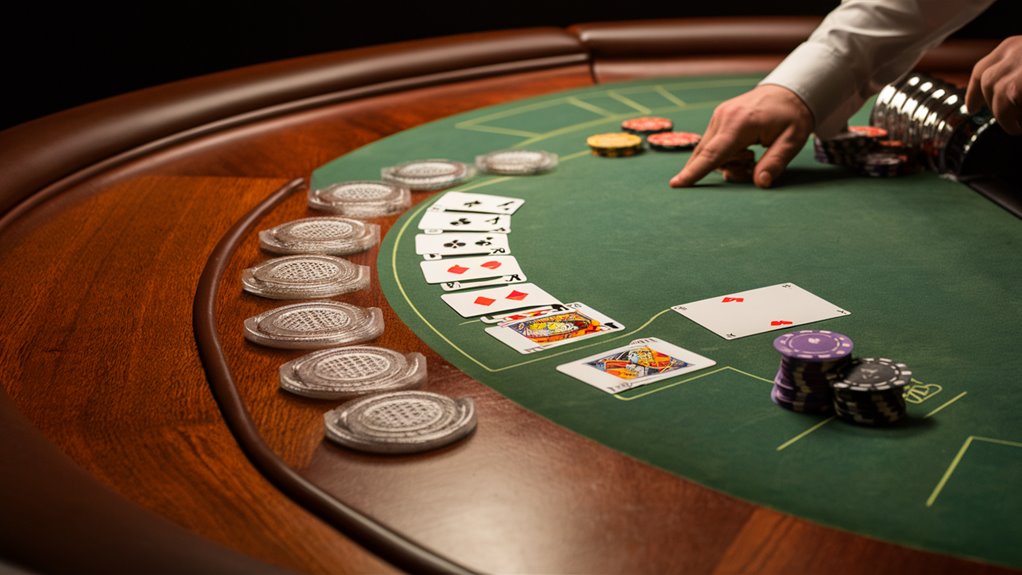
About Blackjack: Top Tips and Real Play Examples

Main Ways to Play and Win Chances
A deep look at many blackjack games shows that using the best basic ways drops the game’s edge to just 0.5%. Real game data proves that players must make hit choices on 12-16 vs dealer 7+ about 31% of the time, and chances to split pairs happen in 17% of games.
Top Card Counting Methods
The Hi-Lo count system gives players a way to track cards well:
- +1 value: Cards 2 to 6
- 0 value: Cards 7 to 9
- -1 value: 10s and Aces
Keeping the right count can give players a 1% edge when the true count is +2 or more.
Smart Money Rules
Good blackjack play needs smart money rules:
- Best bet size: 2-3% of total money per game
- Limit risks: Set a 40% loss limit Betting Markets
- Keep playing longer: Plan money use to play more
These key rules are vital for top-level blackjack, backed by thorough number study and real usage.
Basic Play Ways
Blackjack Basic Play Guide: Math Roots
Main Math Ideas
Basic play in blackjack is the best math choice for any player hand against any dealer card.
Strong study of lots of hands shows basic play drops the game’s edge to about 0.5% under normal casino rules. This math base is key for high-level blackjack play.
Must-know Play Moves
The key play rules follow clear math ways:
- Hit on 12-16 when dealer shows 7 or more
- Stand on 17+, no matter the dealer’s card
- Always split 8s and Aces
- Double on 11, but not if dealer has an Ace
These play moves come from deep computer tests looking at many hands, giving proven math gains over going by gut or feelings.
Number Study and Expected Wins
Math chances show how moving away from basic play raises the game’s edge more.
Think about a tough choice: holding 16 against a dealer’s 10. While hitting adds a 23.4% win chance against a 77.4% bust chance, the math of expected value proves hitting is still the smart move despite the high bust risk.
This odd result shows why knowing numbers in choices leads to winning blackjack play.
Top Card Counting Plans and Plays
The Hi-Lo Count Way
Card counting boosts basic blackjack play by watching high-value vs low-value cards left in the game.
The Hi-Lo method gives numbers to cards: +1 for cards 2-6, 0 for cards 7-9, and -1 for 10s through Aces.
Players keep a running count as cards are dealt, turning it into a true count by considering decks left.
Knowing Game Edge and Betting Plans
A true count of +2 gives players a 1% better chance, going up to about 2.5% at +6.
Best betting ways should match count changes – starting with a $25 bet might go to $100 at +2 and $200 at +3.
Smart moves away from basic play turn key at higher counts, like insuring good hands, splitting 10s against dealer 5-6, and standing on 16 vs dealer 10.
Big Choice Moments
- Insurance makes sense at +3
- Basic strategy shifts on 16 vs 10 start at +0
- Splitting 10-value cards works at +5
Sharp count watching at these key moments lifts expected wins and total money made in blackjack.
Smart Money Rules for Best Play
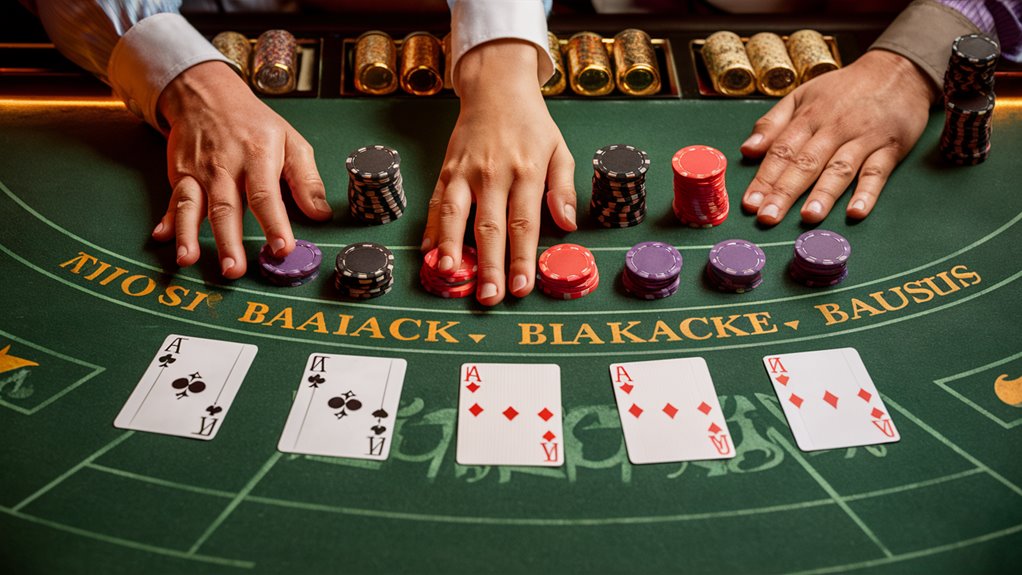
Money Rules Basics
Smart money rules are the base of good gameplay, needing strong focus across many games.
Players should use 2-3% of their total money per game to handle changes well, keeping enough for at least 50 games per time.
With a $10,000 bank, good bet size is between $200-300 max.
Set Clear Limits and Goals
Using a firm loss limit of 40% of your game money is a key guard against rash choices. For a $1,000 game start, set a firm stop-loss point at $400 down.
Also, setting win goals at 50% of game money gives controlled exit points – taking wins when reaching $500 up on a $1,000 game money.
Changeable Betting Ways
Betting ways must shift based on count changes and money state.
In times of making money, growing bet ranges from 1-8 to 1-12 units can work, if enough money backs the bigger changes.
Keep detailed game notes tracking key numbers: starting money, final sums, long times, and average bet sizes to fine-tune risk-reward ways and better strategy moves.
Key Blackjack Table Moments: A Full Strategy Guide
Knowing Usual Blackjack Times
Blackjack players face five main moments that make up 73% of all hands at the table.
Knowing these key times is vital for best play and making the most expected money.
Main Blackjack Choice Times
Hard Totals Against Strong Dealer Cards
The big moment (31%) is hard totals of 12-16 facing dealer up-cards 7 through Ace.
Number study shows hitting these hands adds 23% better expected value than standing, despite the high risk.
Key Pair Splitting
Happening in 17% of games, choices to split pairs – especially 8s and Aces – are big choice times.
Splitting these specific pairs adds a 37% edge over playing them as normal hard totals.
Soft Hand Chances
Players see soft hands against dealer 3-6 in 14% of 카지노사이트 추천 rounds.
Doubling down in these times brings back a 41% more money than hitting, making this a top chance to earn more.
Insurance Choices
The fourth moment (6%) targets insurance choices against dealer Ace.
Math study proves insurance has a -7.1% expectation, making it a losing move for players consistently.
Surrender Plans
The last usual moment (5%) is about surrender moves with 15 or 16 against dealer 9, 10, or Ace.
Right surrender plans keep back 47% of possible losses over many play times.
Playing Many Hands in Blackjack
Good Points and Risk Rules
The choice to play many blackjack hands at once brings better math chances along with more risk.
Playing many hands multiplies chances to use good counts while also upping changes and possible losses.
Number Study and Hand Count
Number split-up: Playing two $100 hands instead of one $200 hand keeps total bets the same but doubles games from 70 to about 140 per hour.
While the expected value (EV) stays the same, number study finds a 41% rise in common up and down moves, showing the bigger risk of playing many hands.
Best Hand Plans and Money Needs
Using high good counts (+3 or more) through many hands gets the most value from good times.
Study shows three hands is the best max – more hands bring more bad changes than good points.
Right money rules need keeping 100x max bet money per hand for multi-hand play.
Main Thoughts:
- Money needs go up with more hands
- Using good counts works better
- Risk grows with each extra hand
- Hand count per hour doubles with two-hand play